














Categories
Blog

What Is a Clamp Meter?

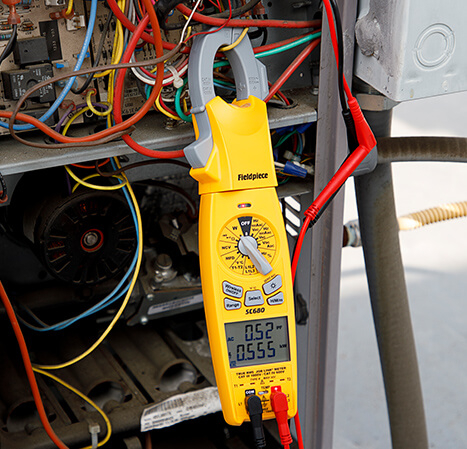
When you arrive at a service call and suspect an electrical fault in a live system, you need a tool that keeps you safe without slowing you down. Technicians rely on clamp meters to measure current without ever breaking the circuit. Whereas a standard multimeter demands that you disconnect conductors to read amperage, a clamp meter’s hinged jaw clamps around a live wire, delivering instant, accurate readings. This capability makes the clamp meter indispensable for HVAC diagnostics.

How HVAC Technicians Use Clamp Meters

Clamp meters go beyond simple amp checks. HVAC professionals depend on them for a broad spectrum of electrical troubleshooting tasks. You can capture inrush current during compressor startup, verify balanced loads across three-phase motors, and spot phase imbalances that shorten component life. Many modern clamp meters also integrate voltage measurement, resistance checks, temperature sensing, capacitance testing, and non-contact voltage detection in one compact tool.

Clamp Meter Benefits in the Field

Using a clamp meter has distinct advantages on every service call. First, you avoid interrupting the customer’s operation as there is no need to cut wires or shut down systems. Second, the quick-clamp action, large jaw openings, and optional swiveling heads let you work in tight panels or around bulky conduits. Lastly, advanced features such as True RMS accuracy, backlit displays, and backlit dials ensure reliable readings under all field conditions. These benefits translate into faster diagnostics, fewer callbacks, and increased on-the-job safety.

Key Features to Evaluate

Selecting the right clamp meter begins with understanding the demands of your work. Consider max amperage first to ensure it can safely measure the expected load without being damaged. Also consider jaw opening size: large enough to clamp around conductors, while compact enough to access wires in tight spaces. Look for AC and DC measurement capability along with voltage and resistance ranges to cover all your basic tests. Verify that the meter carries a CAT III or CAT IV safety rating for industrial environments. Additional features such as built-in flashlights, temperature probe inputs or wireless data transfer to a job-site app can further streamline your workflow.

Fieldpiece Clamp Meter Options

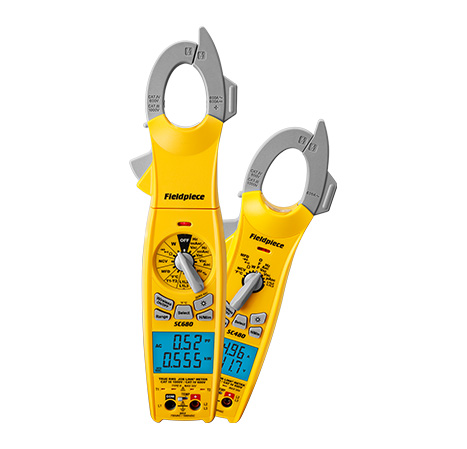
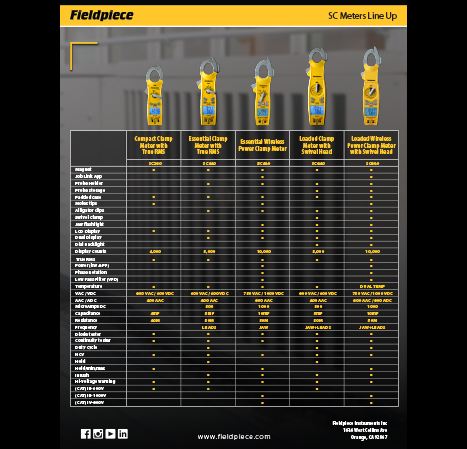
Fieldpiece offers a variety of clamp meters engineered for real-world HVAC challenges. The compact SC260 clamp meter delivers AC current measurement, voltage, resistance, and temperature functions in a compact housing that fits your belt pouch. For advanced troubleshooting, the SC680 adds power quality analysis, phase rotation detection, a 180° rotating head, and wireless integration with the Job Link® System. Both models feature True RMS, large backlit displays, and rugged housing built for contractor demands.

Integrating Clamp Meters with the Job Link® System

Wireless connectivity changes the way you document and share data. With the Job Link® System app, clamp meter readings are transmitted in real time to your smartphone or tablet. This allows you, for instance, to get amp draw while keeping a blower door closed. You can create professional job reports on the spot, which not only enhances customer confidence but also simplifies record-keeping for maintenance programs.

Best Practices for Safe Measurements

Always inspect the clamp meter’s jaw for debris or damage before use. Position the jaw around only one wire at a time to avoid false readings. When checking high-current circuits, stand clear of exposed bus bars and wear appropriate personal protective equipment. Confirm the safety rating matches the voltage category of your application. By following these practices, you maximize the tool’s lifespan and your own safety on every job.

A clamp meter is more than a measurement device. It is a diagnostic tool that enhances safety, efficiency, and precision in the field. For HVAC professionals, choosing a high-performance clamp meter is critical to maintaining system performance and ensuring customer satisfaction.

If you need a reliable way to troubleshoot electrical issues without interrupting service, explore the Fieldpiece line of clamp meters and see how our tools help you work easier, faster and better.
Categories
Blog

Benefits of the 4-Valve Manifold SM480v

As HVACR technology continues to advance, so should your HVACR tools. Fieldpiece is committed to bringing you the best tools to make your jobs easier, faster, and better. Our wireless 4-valve manifolds are no different. Learn more about the benefits of the SM480v.

Focused On Performance
The 4-valve manifold SM480v is the result of years of HVACR experience and feedback from HVACR technicians combined with state-of-the-art technology expertise. Simply put, it is the most advanced digital refrigerant manifold available today.

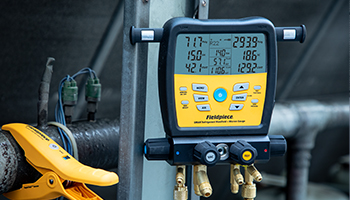
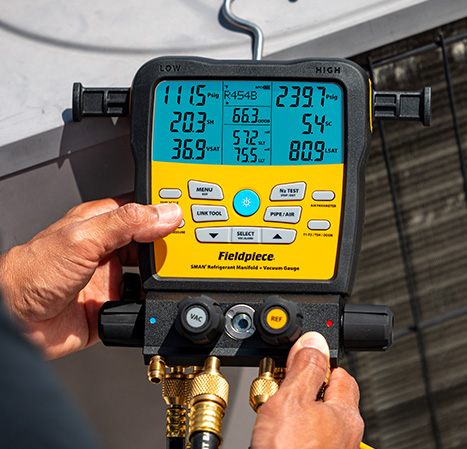
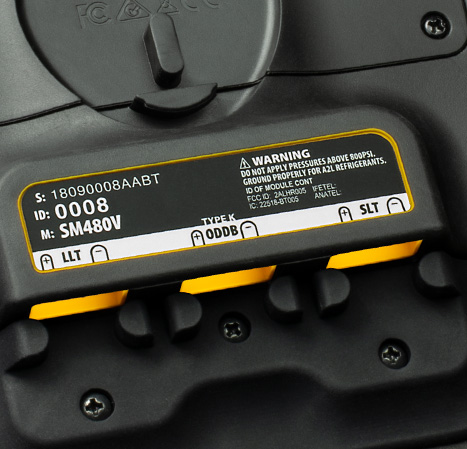
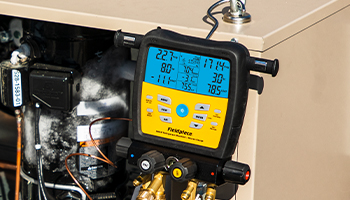
The SM480v easily helps HVACR professionals troubleshoot, evacuate, and charge systems faster. With 4 ports this manifold can handle any job. Thermocouple ports have been moved to the rear for added protection and a streamlined setup. The SM480v also has a built-in micron gauge. The extra-large LCD makes it easier for you to read measurements and live calculations.

Durability
In addition to all of the great technology features, the 4-valve SMAN480v is built to last ‒ heavy-duty casing, water resistance, hermetically sealed sight glass, impact resistant screen, strategically placed thermocouple ports, and reinforced hook.

Wireless
Make performing your job even easier by adding the Job Link® System App. With a wireless range of up to 1000’, the SM480v gives you the flexibility to move around the job site and still see all the measurements you need on your mobile device.

The 4-valve manifold SM480v can also receive and display live wireless measurements from other Fieldpiece Job Link tools such as Job Link Pipe Clamps (JL3PC), Job Link Psychrometers (JL3RH), and SRS3 Refrigerant Scale. Talk about making your job more efficient!

Tightness Test
The 4-valve manifold SM480v also has many features that help as you check for leaks after installations or repairs. Fieldpiece knows how important it is to get things right. With the SM480v, you can know if a drop in pressure during the tightness test is due to a leak in the line set or simply a change in the ambient temperature. Additionally, you can view pressure differential over time and a timer tracks the duration of the test.

Log Data
One of the best features of this tool is how it can store data from your jobs. The 4-valve manifold SM480v can store up to nine different jobs and can log 168 continuous hours of work ‒ that is equal to seven days!

Here at Fieldpiece, we want to help make life for HVACR technicians easier. Visit fieldpiece.com to learn more about the 4-valve manifold SM480v and other HVACR tools we have to offer.

Categories
Blog

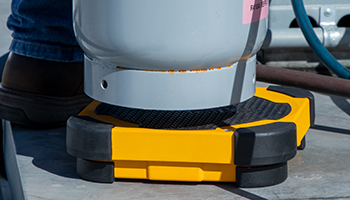
The Benefits of Using a Refrigerant Weight Scale When Charging HVACR Units

Refrigeration scales play an important role in the HVACR industry. They are used to measure the weight of refrigerant recovered from and charged into a system.

The information is used to determine the amount of refrigerant that should be put into the system is either the manufacturer recommended spec or based on superheat or subcooling calculations. In this process of charging to the correct amount of refrigerant, the weight scale plays one of the following two roles:

  • For charging based on manufacturer spec, the scale confirms the technician adds the correct amount of refrigerant into the system.
  • For charging based on superheat or subcooling, the scale tracks how much refrigerant was needed in order to meet the superheat or subcooling requirements.

The primary benefit of weighing refrigerant using a refrigerant weight scale when charging HVACR systems is to prevent undercharging or overcharging the unit.

Undercharged Unit
An undercharged HVACR system typically occurs because there are leaks in the refrigerant line sets. This results in the refrigerant slowly escaping out of the system. As refrigerant levels decrease, the compressor can overheat causing damage and a shortened lifespan of the compressor or cause the compressor to fail completely. Additionally, an issue like freezing coils can occur.

Overcharged Unit
While less common, overcharging an HVACR system can occur. If an HVACR unit is filled with too much refrigerant, the refrigerant won’t be able to change between liquid to gas and vice versa which leads to inefficient cooling. The compressor will have to work much harder than normal causing higher operating costs and the HVACR system to wear out faster. Overcharging can also lead to liquid refrigerant flooding the compressor causing it to fail, requiring the entire system to be replaced.

Ensuring the HVACR system is properly charged is critical and using a professional refrigerant weight scale is the best way to ensure that. Fieldpiece has scales designed and built for the rigors of HVACR and are the most state-of-the-art in the industry. Visit fieldpiece.com today to learn more.

Categories
Videos

Customer Testimonial: Vader Air Conditioning & Heating Inc.

Vader Air Conditioning & Heating Inc., a local & veteran-owned indoor comfort company, explains why they choose Fieldpiece as their go-to for HVAC tools.

Categories
Videos

Fieldpiece Wireless Products All-Star Lineup

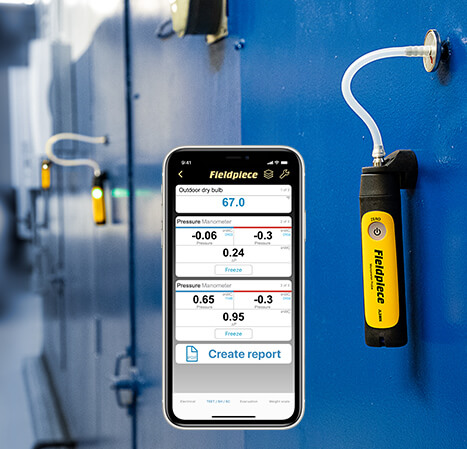
Fieldpiece Instruments knows how to assemble a winning team of online HVACR wireless tools. And like a good coach, the Job Link® System seamlessly integrates the functionality of these amazing products, delivering real-time readings to smart phones or tablets.

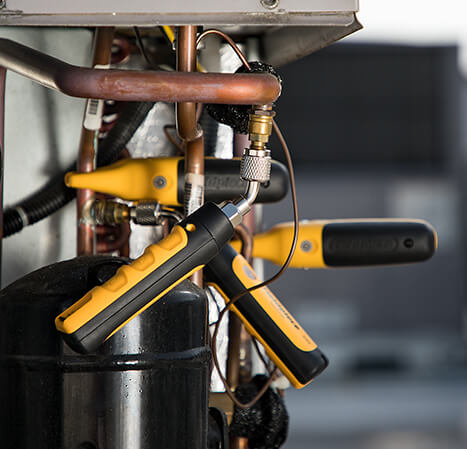
First on the field are the rugged SMAN Refrigerant Manifolds – SM380V and SM480V. These powerful HVACR wireless tools play well with the wireless scale, pipe clamps, and psychrometer. Next in the lineup, the Job Link® System Flex Psychrometer Probe boasts a generous 1000’ wireless range and delivers on-the-spot live readings. This flexible wand needs only a 3/8” hole for duct testing and handles extreme temperatures from -40ºF up to 250°F.

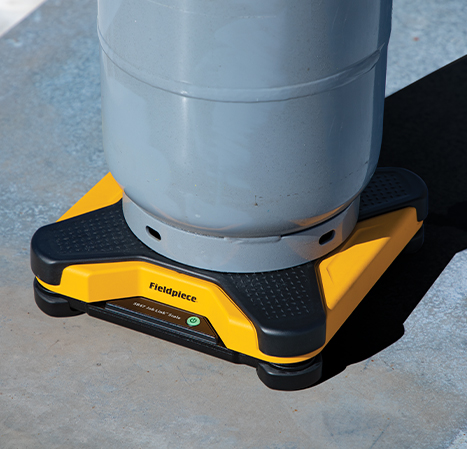
The Wireless Refrigerant Scale SR47 (replacing the SRS3), another dependable HVACR wireless tool, handles a capacity of 252 lbs., and the sealed electronics protect the SR47 from moisture. The Wireless Vacuum Gauge MG44 rounds out the starting lineup of HVACR wireless tools. With its smaller cylindrical shape, no-slip grip, reversible angled coupler, and water-resistant case, this tool delivers accurate readings from hard-to-reach areas. Fieldpiece Instruments brings the winning line-up to make the HVACR professional’s job easy and successful.

Categories
Blog

What is a HVACR Manifold Gauge?

There are a lot of working parts in a HVACR system that needs to be checked out regularly for maintenance. An important tool that you will need is a HVACR manifold gauge.

A manifold gauge is used to check the pressure of refrigerants in HVACR systems. It is a necessary tool in order to diagnose if the system is correctly charged with refrigerant as well as to help service any issues. A HVAC gauge can be used for many different functions such as checking pressure, adding refrigerant, and determining if there is a leak.

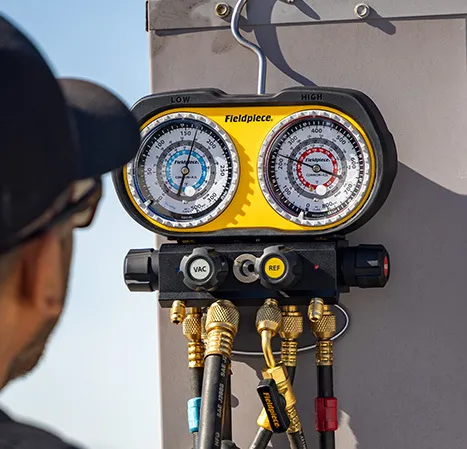
There are different types of hvac gauges and often a HVACR technician may have multiple sets depending on the type of jobs they have. There are 2-valve and 4-valve manifolds. The gauge can be either analog or digital. Many digital gauges now have Bluetooth built-in for connecting to smartphones.

When deciding on a manifold gauge to buy, it is important to ensure the gauge is designed to withstand the rigors of field use including heavy duty casing, reinforced hook, water resistance, and impact resistant screen. Additional features such as data logging and strategically placed thermocouple ports are beneficial.

If you are looking for a manifold gauge, Fieldpiece can help. Visit fieldpiece.com today!