













Categories
Blog

Unlocking Efficiency: Reasons to use a Valve Core Removal Tool

Refrigerant recovery, system evacuation, and charging are the “bread and butter” processes that HVACR techs routinely tackle. Removing one of the smallest components of a system, the valve core, significantly increases the speed and efficiency of these tasks. Valve cores can block up to 90% of the flow, therefore removing it to increase the flow rate makes a valve core removal tool an important part of any HVACR tech’s toolkit.

Why Pull a Valve Core

The initial, primary purpose of a valve core removal tool (VCRT) was to replace a damaged core on a charged system without losing the refrigerant charge. By replacing the damaged valve core without having to pump down the system, you save significant time on the job.

The time saving advantages discovered in using a VCRT to replace a damaged valve core led to the best practice of removing the valve core to recover, evacuate and charge systems faster.

Removing a Valve Core on a Charged System

One of the first steps before installing a VCRT is to understand the open and close positions of the ball valve to prevent accidental refrigerant loss. When installing a VCRT on a charged system, it’s important to hand tighten the tool at the service port to prevent leaks, but not overtighten. Overtightening creates more stress on the gasket causing it to wear out faster and potentially leak.

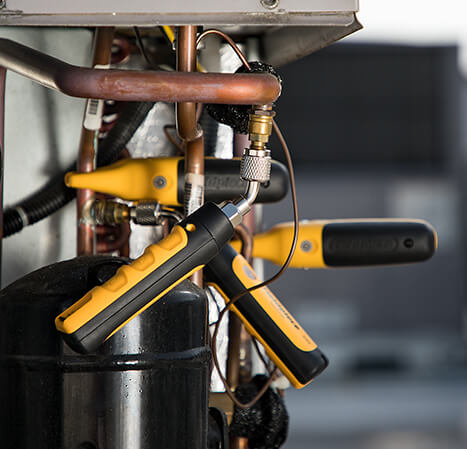
With the VCRT installed and the integral ball valve open, slide the capture rod towards the service port valve core and slowly turn the rod tip to align on either side of the valve core. You will feel the capture tip slot into place. To firmly secure the core into the tool, slightly press the cap to ensure the core is press-fit into the capture tip. Turn the VCRT cap counterclockwise approximately five full turns to unthread the valve core and slide the capture rod back out. You can now close the ball valve, isolating the charged system, and remove the capture rod assembly with the secured valve core.

Some VCRTs, like the Fieldpiece VC1G and VC2G, have an integrated sight glass that allows you to visually confirm that the valve core has been captured before removing the capture rod from the tool. Verifying the core is captured eliminates the “Did I get it?” game saving even more time. Additionally, you can check that refrigerant is flowing through the sight glass. Once the valve core is removed, your hose can now be attached to the VCRT to begin the recovery process.

Removing the Valve Core for System Evacuation

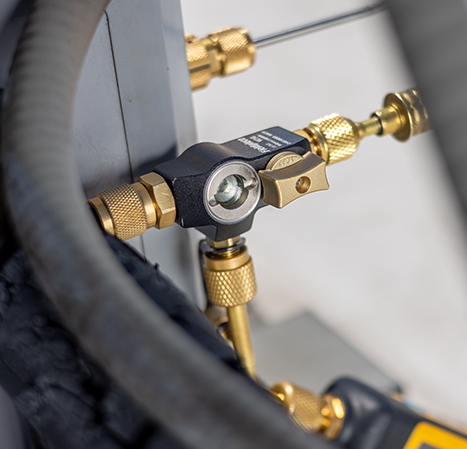
Once you have repaired the system, performed a nitrogen pressure test and are ready to evacuate the system, you can install your micron gauge on the VCRT side port. Note that the most accurate vacuum measurement is taken at the system service port location. A VCRT with two ball valves, like the Fieldpiece VC2G, allows you to directly connect, isolate and protect your micron gauge during refrigerant recovery and charging without additional fittings. With the system at atmospheric pressure, you can now swap your recovery hose with a larger diameter vacuum hose to further speed up the evacuation process. A tip while evacuating is to open and close the VCRT ball valve to remove any trapped air in the ball valve.

Another important tip is to not insert or remove a valve core under a vacuum. This will introduce air back into the system that you just evacuated. The system should be slightly pressurized prior to inserting the core. Simply reverse the removal process to install the valve core back into the service port. Note that the best practice is to install a new valve core every time you remove one.

Removing the valve core is a common and important step for faster recovery, evacuation, and charging. Make your job even easier by picking up a Fieldpiece valve core removal tool that eliminates the guesswork and helps you work smarter.

Categories
Blog

Know You’ve Got It with Fieldpiece Valve Core Removal Tools

During peak cooling season, removing a valve core on the job is as common and necessary as finding shade. Removing the core opens the valve completely, eliminating flow restrictions for faster recovery, evacuation, and charging. To simplify your job, Fieldpiece has a lineup of three ac valve core removal tools (VCRTs) that eliminates the trial-and-error process (and frustration) often faced with other tools.

Locked In
With a press-fit gasket design, the tip of the capture rod locks in the valve core the first time, every time. No adjustments necessary. With the valve core reliably secured, it won’t fall off within the tool or get lost once it’s removed. All models of Fieldpiece ac valve core removal tools have a magnetic cap on the capture rod to safely store the locked-in core on the system housing, keeping it clean and handy. PRO TIP: best practice is to always replace the removed valve core with a new one.

Seeing is Believing
Almost every technician has played the “Did I Get It?” game when removing the valve core. With no way to confirm that the core has been successfully captured before removal, you are left to remove the rod and check, releasing some refrigerant with each attempt. Also, if the core has fallen off within the tool, a quick (and dangerous) opening of the valve on a charged system can eject the core at high speed. Did we mention the frustration that sets in after multiple failed attempts to remove the core? To eliminate this annoyance, the Fieldpiece VCG1 and VCG2 feature an integrated sight glass. You can clearly see the end of the rod through the sight glass and confirm the valve core is attached before extracting it – sanity intact. The sight glass can also be used to verify that refrigerant is flowing.

Two’s Company
The VCG2 model also includes a second ball valve on the side port. This convenient addition allows you to easily isolate and protect a connected vacuum gauge from refrigerant contamination. Since the second ball valve is integrated into the VCRT, you no longer need to add a fitting to gain an isolation valve, which increases bulk and introduces a new potential leak point.

Made to Fit your System
All three Fieldpiece ac valve core removal tools come standard with a 1/4” service port fitting that may be swapped with an optional 5/16” fitting on the jobsite. You no longer need to purchase and haul additional VCRTs to accommodate different system ports, simply keep the swappable fitting in your toolkit. Fieldpiece VCRTs are the right tool, every time.

Thumbs up!
Inserting a core when a system is pressurized can be awkward, except when you have a comfort spinner! The VC1G and VC2G tools feature a rubber-coated, free-spinning cap that lets you use your thumb to hold the capture rod in place, against pressure and easily thread the core with your other hand. Another tech-friendly feature from Fieldpiece.

It’s a Fieldpiece
The VCRT lineup is another addition to our arsenal of rugged tools designed to make life easier for technicians everywhere. We stay committed to innovating in the HVACR industry and providing tools and instruments that survive the test of time while making jobs easier, faster and better.

Categories
Blog

Before the Charge: A Guide to Nitrogen Leak Testing

Fieldpiece is always looking for innovative ways to make tech’s job easier, faster and better, and the combination of Job Link Probes and the Job Link System App do just that. Did you know that you can now use these tools to conduct a temperature compensated, nitrogen pressure leak test? Let’s walk through when to run a pressure test and some of the key steps in the process.

If you’re conducting a service call and have made repairs on a system, it’s important to make sure that it’s a clean, dry, and tight system – especially if you brazed new copper, added flared connections, or repaired other mechanical connections. A nitrogen pressure leak test is an excellent way to ensure that the system doesn’t have any leaks before charging it.

It’s recommended to run a pressure test, also called a tightness test, after a leak has been detected and repaired, or on new installs before charging with refrigerant. The test fills the system with nitrogen under pressure to determine whether it can hold that pressure over time, verifying there are no leaks. Nitrogen is an inert gas and is much safer and cheaper to use than refrigerant.

Before adding nitrogen and conducting a pressure test, record the initial pipe temperature and determine the length and volume of the tubing that is being filled to calculate the amount of nitrogen you will need. Then, make sure there aren’t leaks at the Schrader cores. You should also test your hoses and anything else connected to the system during the test.

Start by purging the system with nitrogen. This is different than flowing nitrogen – that’s at a much lower pressure. Purging allows nitrogen to flow into one side of the system and then out the other. This displaces all excess oxygen and air in the piping. Since you’re working with gas under pressure, be sure to work safely. Any gas under high pressure should be handled carefully and transported per the Department of Transportation guidelines.

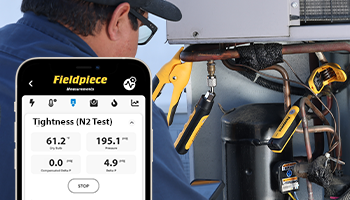
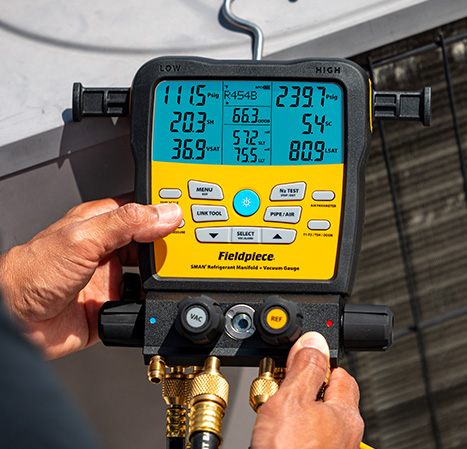
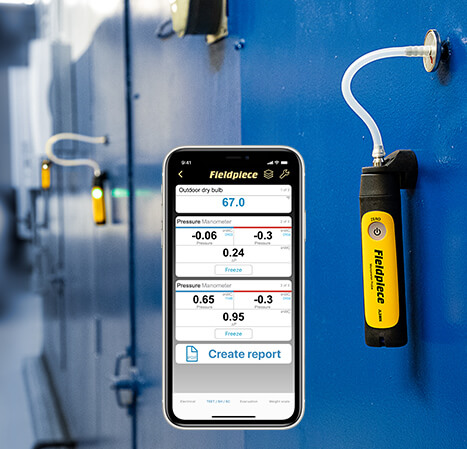
After purging, replace the valve cores if you removed them, and attach a pressure regulator to the nitrogen tank and a charging hose to the service port. Be sure to use a regulator that is made for nitrogen and properly sized for the target pressure. Attaching a Job Link® System JL3PR Pressure Probe to the system can offer additional accuracy compared to the standard regulator dial. To monitor temperature, connect a Fieldpiece JL3PC Job Link® System Pipe Clamp to the system. Note that you can also use your Fieldpiece SMAN® digital manifold to run a nitrogen pressure test.

Once the system is prepared, start to slowly pressurize the system. Start with 100 psi and let the system sit for a minute. Then add another 100 psi and let it sit again. Typically, the recommended test pressure range falls within 200-600 psi, but check the system manufacturer’s specifications. If you’re pressurizing the low side of the system, use the manufacturer’s rated test pressure. Note that a stepped process that gradually increases pressure is not only safer, but it can also prevent wasting time and nitrogen.

Once the system is under pressure, isolate it by removing the charging hose and capping the Schrader port. If you’re working on a residential system, let it sit for 30 to 60 minutes. Some larger, commercial systems require a nitrogen pressure test to sit for 24 to 48 hours. Check with the manufacturer’s recommendations for the exact time needed.

If the system needs to sit for an extended period, temperature fluctuations in the environment will affect the pressure of the nitrogen in the system. Make sure to compensate for these changes in pressure before concluding that a system is leaking. Note that the new pressure test feature in the Job Link System App compensates for temperature fluctuations, as does the Fieldpiece SMAN digital manifold.

If you see a drop in the temperature compensated pressure over time, it means there is a leak. Bubble test every fitting and connection to find the source of the leak. This includes every field-fabricated joint in the system. Any of these could be a potential leak point.

When performed correctly, a nitrogen pressure test is an easy and safe way to determine if a system can be charged with refrigerant. Download the latest Fieldpiece Job Link ® System updates from the app store to include the nitrogen pressure test features. Learn more at www.Fieldpiece.com.

Categories
Blog

A Quick Primer on Furnace Pressure Switches

Now that we’re in the middle of heating season, we bet you’re making more and more service calls for malfunctioning or under-performing furnaces. During these calls, it’s important to make sure that the furnace pressure switch is functioning as intended.

The furnace pressure switch opens and closes to prevent harmful combustion gases from entering the living space and to prevent furnace fires and potential explosions. An elastomeric diaphragm within the switch remains open when the furnace is off. When the furnace is turned on and functioning correctly, the diaphragm operates under the correct pressure created by the draft inducer motor. This completes an electrical circuit that allows the furnace to ignite for the heating cycle. If the pressure conditions are outside of manufacturer specifications the switch will open to initiate a shut-down to prevent the creation of an unsafe environment for residents and technicians.

When examining a pressure switch, start by using a CO detector to check for harmful gases to ensure you can work safely. Then, run the furnace through its cycle. If you notice erratic ignition cycling when there is a call for heat from the thermostat, that may indicate that the diaphragm or the pressure switch is old and could need replacing. Also, check to make sure that the furnace is properly vented.

If the furnace tries to cycle but stops during start-up and then shuts down, it may be because of a faulty pressure switch. In this case, check for a clogged hose port, a blockage in the flue, corrosion or debris blocking the switch. A bad spring could also be the culprit. All of these should be examined.

To test a pressure switch, an ideal tool is the Fieldpiece SDMN6 Manometer Dual Port w/ Pressure Switch Tester. This versatile manometer allows a tech to use the ports to quickly connect to the switch while it’s still in place, confirm that it’s operating correctly and even verify it is performing within manufacturer specifications.

When a pressure switch is faulty and requires replacement, a good piece of advice is to keep a supply of universal pressure switches in the truck. This quickly helps get a furnace back to operating properly. When replacing a faulty switch with a universal switch, it’s best practice to notify the property owner. Given the importance of the proper fit and setting of a pressure switch, some owners may be willing to wait for the procurement of an OEM part for additional piece of mind, or even request a future update from a universal switch to the OEM. This will allow for their system to be operable until a follow-up call can be made with the requested pressure switch.

The pressure switch is an important piece of every heating system and knowing how to examine, test, calibrate and replace them is a critical job for techs and the Fieldpiece SDMN6 is the best tool for the job. Learn more about the SDMN6 at Fieldpiece.com.


Categories
Blog

Measuring HVAC Total External Static Pressure with a Digital Manometer

Measuring a system’s static pressure is a bellwether to HVAC system performance, similar to measuring your blood pressure to determine overall health. Static pressure is the resistance against airflow in an HVAC system that must be overcome to deliver warm or cool air to a conditioned space. Manufacturers of air handlers and furnaces design their systems for optimal performance at or below a specified Total External Static Pressure (TESP). And measuring TESP with a digital manometer is just one way to help techs diagnose and troubleshoot HVAC systems. 


How to Measure TESP

TESP is measured using a dual port manometer with probes inserted at the return side, typically after the filter, and the supply side of the furnace or air handling unit. Test ports will likely need to be created, so it’s important to be cautious and drill outside of the manufactured box in order to not puncture the coil, blower or heat exchanger. While the optimal TESP will vary based on the equipment, a typical system will run most efficiently at or below 0.5” water column (w.c.). What that means is that you don’t want to see a static pressure buildup in the return and supply that is higher than the specified TESP because it’s harder for the blower to work as designed and effectively move air. 


Zero and Align Probes

Before inserting the hoses or probes into the test ports, hit the “zero” button on the manometer to make both port 1 and port 2 equal relative to each other and to the atmosphere. Insert the manometer hoses or probes so that the openings are perpendicular to the direction of airflow. More repeatable and accurate results can be achieved with static pressure probes instead of hoses. The probes with a magnetic base and arrow marking that aligns the probe tip into the airflow provide the highest guarantee of successful placement. 


Taking Measurements

Once the probes are inserted and the system is operating at the highest airflow speed, wait approximately three minutes for the system to stabilize before taking measurements. Note that after a few minutes field manometers will drift, so it’s also important to reset with the “zero” button before each use. 

Add the absolute value of the port 1 and port 2 measurements together to determine the TESP and compare to the manufacturer’s specified TESP. Some manometers will only provide the differential value, rather than a supply and return value. Fieldpiece manometers, such as the SDMN6 and Job Link® JL3KM2 Probes have independent sensors for each port so that if the TESP is not in compliance, you can troubleshoot more quickly by targeting the side of the system with the largest variance. 


Diagnostic Tips

If the TESP exceeds the manufacturers specification, some common causes include dirty filters, blocked ducts, closed dampers, an unbalanced system, undersized ductwork, kinked flex duct or too much airflow. Under these conditions, fixed speed and variable speed motors will not operate optimally and experience premature failure.

With a much lower than specified TESP, common causes include leaky ductwork, separated duct connections, missing filters and low fan speeds. Resulting poor system performance typically means that a space is not being cooled or heated appropriately and the customer is not comfortable. 

Using a digital manometer, techs can see the results of irregular maintenance and poor installation practices reflected in an out-of-spec TESP measurement. Whether you’re servicing a furnace, air conditioner or heat pump, airflow analysis and measuring total external static pressure is a critical indicator of a system’s health.  

Categories
Press Releases

FIELDPIECE INSTRUMENTS LAUNCHES LINE OF HVACR VALVE CORE REMOVAL TOOLS

New VCRTs Help Technicians Recover Refrigerant Faster and with Confidence Every Time


ORANGE, CALIF. (January 22, 2024)Fieldpiece Instruments, the leading manufacturer of tool and test instruments that enhance the work of HVACR professionals, introduced three valve core removal tools (VCRTs) designed to improve system charging, recovery and evacuation tasks. VCRTs remove the valve core from service valves in air conditioning, heat pump, and refrigeration systems to replace defective cores and provide an unobstructed flow of refrigerant for faster servicing. The Fieldpiece VCRTs represent a significant leap forward in valve core removal technology, overcoming the limitations of existing tools.

One of the game-changing features within the Fieldpiece VCRT lineup includes an integrated sight glass that allows technicians to verify at a glance that the valve core is captured prior to removing it and confirm when refrigerant is flowing. Fieldpiece eliminated the frustration that techs face when it takes multiple tries, and lost refrigerant, before the valve core is captured with current competitive products. The Fieldpiece VCRT capture tip also includes an interior gasket that the valve core pin presses into to secure it for removal. No more fishing around for lost valve cores – a solid grip guarantees that the job is done right the first time, every time.

Another Fieldpiece exclusive feature is a comfort spinner, a free-spinning, rubberized cap that makes removing and inserting the valve core, while under pressure, easier and more comfortable. Like the sight glass, this comfort spinner is available on the VC1G and VC2G models. All three VCRT models, including the ultra-compact VC1, include a magnet in the cap to keep the removed valve core on hand during service.

All VCRT models are equipped with a 1/4” service port fitting that can be swapped in the field with an optional 5/16” service port fitting for mini-split systems, conveniently reducing the number of tools to carry. Replacement capture rod assemblies also streamline the maintenance process. Techs can say goodbye to deep-buried O-rings, as these simple replacement kits reduce downtime and expedite the repair process.

The premium VC2G tool features a dual ball valve design that protects attached vacuum gauges and pressure probes and adds versatility for connecting hose lines and isolating system service ports.

“Our VCRTs offer benefits that current VCRTs on the market do not have,” notes Jeb Ball, vice president of sales and marketing at Fieldpiece Instruments. “We collaborate with techs to understand the pain points and develop solutions that enhance their jobs. The VCRT line expands our arsenal of tools built for efficiency, versatility and durability, and underscores our commitment to innovations that allow technicians to work faster with more reliable results.”

The new line of A2L compatible VCRT’s is being showcased at AHR Expo, January 22-24, in Fieldpiece Booth #S9334. Wholesalers are purchasing inventory now and product will be available to techs in April. To learn more about the benefits of Fieldpiece VCRTs, visit https://www.fieldpiece.com/valve-core-removal-tools.

# # #