







Categories
Blog

Using the Job Link® System to Easily Measure Delta T

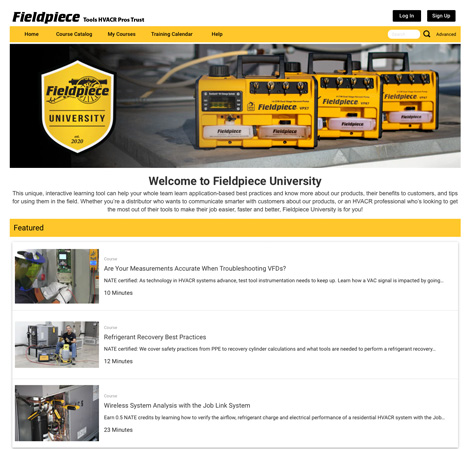
The Job Link® System offers some amazing and convenient tools for HVAC professionals. To help you make the most of these tools, we offer tons of free educational content on Fieldpiece University. This site is packed with resources to help you to advance your skills and utilize every awesome feature of our products.

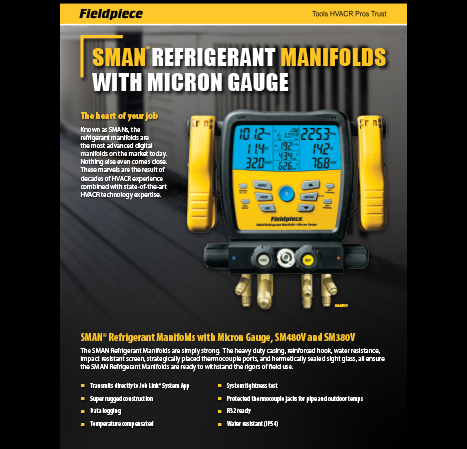
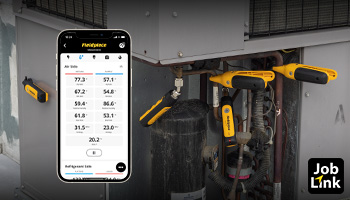
One of the resources at Fieldpiece University is our breakdown of how the Fieldpiece SM380V SMAN Refrigerant Manifold 3-Port I Wireless works seamlessly with the Fieldpiece JL3RH Job Link® System Flex Psychrometer Probe® to make measuring the Delta T an easy process.

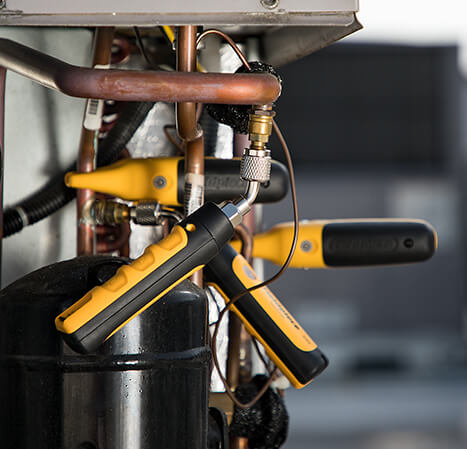
To measure the Delta T, start by attaching a couple JL3RH psychrometer probes to the system. One probe should be attached to the return side of the air handler and the other to the supply side. Be sure the psychrometer attached to the return is set to red and supply to blue.

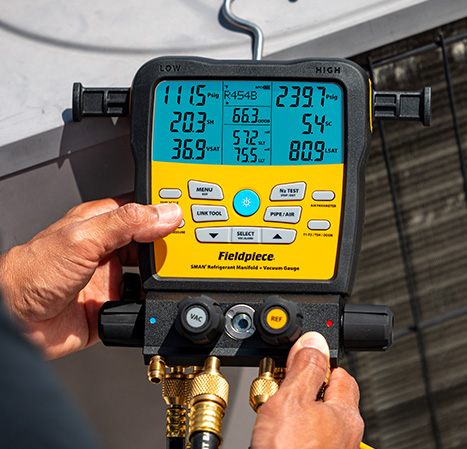
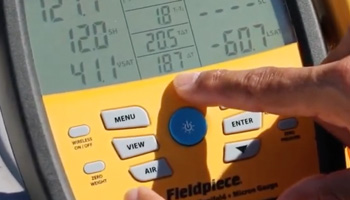
Once they’re installed and turned on, connect them to the SM380V. To display Delta T on the manifold, press the “Air” button on the manifold and cycle to the “Dry Bulb” setting. On the screen, you’ll clearly see the return temperature and the supply temperature. The manifold automatically calculates the Delta T.

Along with calculating the Delta T, the manifold and probes provide the system’s target Delta T by automatically taking the air properties from the return wet and dry bulb and calculating what the Delta T should be given load conditions.

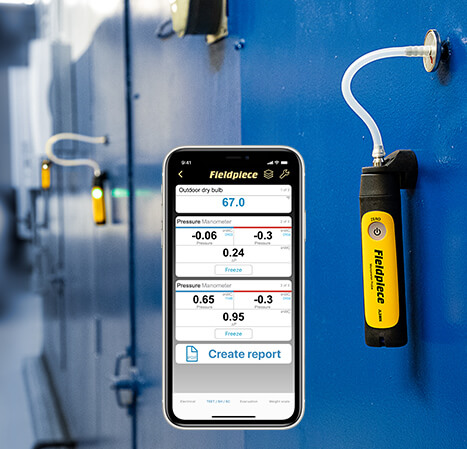
Ideally, measurements are taken at the air handler. However, if for some reason you are unable to take return and supply measurements there, the Job Link® System is adaptable. Because Job Link® System tools are wireless, they can be placed at return and supply vents inside a structure as well. Each probe magnetically attaches to an internal return or supply vent and still delivers all the measurements required to calculate Delta T or any other needed values.

Together, the SMAN and JL3RH wireless psychrometers relay their important information directly to the Job Link® System App—giving techs the ability to monitor measurements from anywhere on the job site and also quickly and easily generate Job Link® performance or maintenance PDF reports.

The flexibility of being fully wireless allows a tech to “be in multiple places at once” and work smarter, faster and more efficiently. Learn more at Fieldpiece University.



Categories
Blog

Real-World Ways Wireless Tools Change the Game

The advances made with wireless tools are some of the most exciting in our industry in a long time. Smart HVACR tools and applications like the Job Link® System App and family of tools are making work faster and smarter, while also allowing technicians to enjoy much greater precision while diagnosing and repairing a system.

Here are four ways smart tools change the game!

  1. See the big picture

Since wireless tools offer seamless connections between digital manifolds, manometers, clamp meters and even scales, they allow technicians on a jobsite to see the big picture view of the system. Right from their mobile device, they see all the necessary data points to make a diagnosis—from superheat and subcooling to refrigerant pressure and more. This helps techs troubleshoot the system quickly and problem-solve with greater accuracy by bringing together disparate pieces of data to show how various adjustments impact performance.

  1. There’s an app for that

The latest wireless HVACR tools, like those in the Job Link® System, work with apps on most iPhone and Android mobile devices. There’s no need for technicians to invest in a new piece of purpose-built technology to take advantage of this functionality. From the mobile device already in their pocket, techs are able to easily access information from across the jobsite while also enjoying quick reference to customer data stored in the cloud. This functionality offers greater accountability and transparency about the work being performed today and on previous service calls. Plus, Job Link is free to use! 

  1. Put tools exactly where they’re needed

A wireless HVACR tool with a long range eliminates wasted time. Using traditional wired tools means a lot of hooking up and unhooking of a single probe or tool, making adjustments in one location and then walking back to check the reading, and so on. Also, some ideal locations for a probe could be far from an outlet or difficult to reach. Using a wireless manometer, temperature probe or pipe clamp, for example, allows the tech to choose the ideal location for a measurement. Once each tool is installed, they function independently while delivering data in real-time directly to the mobile device.

  1. Lighter loads

Wireless tools not only remove the hassle of long extension cords and looking for outlets to plug them into, they also reduce the weight of the equipment that a tech needs to carry around a jobsite; not to mention, the number of trips up and down the ladder that they save.

Wireless tools help techs work smarter and faster. Pick up some of the latest innovations from Fieldpiece.

Categories
Blog

Women Making an Impact in HVACR

As we celebrate International Women’s Day on March 8, we want to recognize a few of the women in the HVACR space who are making an impact in the lives of future techs and helping to train and equip those around them.  This includes instructors and trainers in the field as well as some of our own employees who are making the tools and test equipment we all use and love! At Fieldpiece, we thank you for your impact, your commitment to the HVACR industry and to training the next generations of techs.

Michele Seaman, the HVAC/R Program Director Western Dakota Tech. Michele, we thank you for your dedication, passion and advocacy for your students.  The Western Dakota Tech program competes in SkillsUSA every year and she is so committed to helping them reach their potential.  Thanks for being a role model and for inspiring your students every day!

Crystal Naegle of the UA Local 525 in Las Vegas, NV, we see you! Crystal is an instructor and HVAC coordinator, has been toseveral trainings and conferences the past few months.  She’s been actively honing her skills and bringing them back to her home city where she has been developing an intensive HVAC training program for apprenticeship and journeymen.

We’d also like to give a shout out and recognize this year’s Lady of the Trade nominees at the recent @hvactactical awards in Atlanta, GA.  These fantastic women are sharing their daily HVACR field experiences on social media.  This gives visibility and encouragement to everyone about the variety of jobs and situations any HVACR tradesperson will see out there.  So here’s to Emily @hvac.chick an HVAC apprentice in San Diego, CA and Shawna Peddle @hvac.optimist a Level 3 commercial HVACR apprentice in Canada.  Congratulations, Brandi Ferenc @chlrchk, who was this year’s award winner and who serves as a Refrigeration Mechanic Gas Fitter 1 HVAC instructor and mentor in Ontario, Canada!

Manufacturers also have women in the trade, so we’d like to recognize one of our own.  Nicole Schneegas, is an Industrial Designer here at Fieldpiece.  She’s one of two industrial designers who help create all of our products and how they end up looking and feeling in your hands.  Not to mention ensuring all of the technical manuals, tool bags and the packaging also look great!  As one of the younger members of the Fieldpiece team, we look forward to her many future contributions too.

Mentorship and fellowship also deserves a mention here.  Thank you to organizations like Women in HVACR who are bringing the industry and techs together and creating opportunities for connection, insights and growth across all areas of the HVACR community.  It creates a great foundation for collaboration and mentorship for men and women who want to help prepare future generations and keep us all working towards a collective goal of keeping the trades inclusive.

There are so many deserving women who work tirelessly behind the scenes and many more that are in industry or the face that the customers see.  If you know of a woman in the HVACR trades that deserves a mention, please write it in the comments.  She may just be a feature in a future article!

Categories
Videos

JOIN OUR TEAM | Beta Tester Program

Are you a fan of Fieldpiece products? YOU can help us develop our next HVACR innovation! Apply for our Beta Tester Program to help us make HVACR Tech’s jobs easier, faster, and better. OR, if you want to show us your HVACR Pro skills firsthand, sign up for our Ride Along Program to help us learn what we need to improve or focus on next.

Click the link below to get started!
https://www.fieldpiece.com/beta-tester/

Categories
Blog

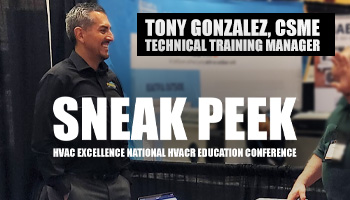
Fieldpiece Technical Training Manager Speaks at National HVACR Education Conference

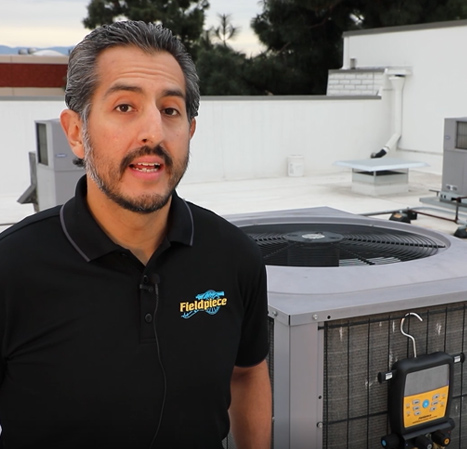
Tony Gonzalez, Technical Training Manager at Fieldpiece Instruments, is speaking at the 2023 HVAC Excellence National HVACR Education Conference in Las Vegas! Take some time to learn at:

You might know Tony from our training videos, and with over 17 years of experience in the HVACR industry, his expertise and knowledge on Fieldpiece technology are unmatched. He’s also a great teacher. During his two presentations, he’ll break down some of his insights and  information expected to be invaluable to HVACR students and educators alike.

His in-person presentation—Unlock the Power of Wireless Technology for System Troubleshooting and Service —covers some of the latest wireless technology tools that HVACR techs use every day in the field to troubleshoot systems quickly and efficiently. The smart tools he’s showcasing are game-changers and the presentation covers ways that techs should leverage them to work smarter, not harder.

Modern wireless technology allows tools to gather multiple data points from many different parts of a system simultaneously. And with a range of 1000 feet, Fieldpiece’s tools let techs keep an eye on pressures and temperatures from across a worksite. The technology also makes it possible to evaluate and adjust all aspects of system performance in real-time—enabling

Techs to achieve peak system performance in the shortest amount of time possible. Finally, Tony’s presentation includes how to incorporate wireless technologies into training programs and instruction protocols—making it easier to troubleshoot, charge and repair equipment quickly and efficiently.

We hope to see you at the conference and look forward to hearing your thoughts on Tony’s sessions!

Categories
Blog

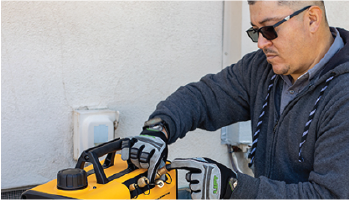
Buyer’s Guide: What to Look for in an HVAC Vacuum Pump

HVAC vacuum pumps are an essential tool for HVAC technicians and contractors, as they play a crucial role in removing air and moisture from the refrigerant system before charging it with refrigerant. A vacuum pump helps to ensure that the HVAC system operates efficiently and effectively, thus providing another happy customer indoor comfort and lower energy costs.

When looking for an HVAC vacuum pump, there are several key factors that you should consider to ensure you make the right choice. Here are some of the most important ones:

Oil Condition and Changes

Clean oil plays an important role in the performance of your HVAC vacuum pump, and is the single most important factor in how quickly a vacuum pump can remove all moisture and non-condensable gasses from an HVAC system. They should provide clear visibility of the condition of the oil, those with a backlit reservoir being the easiest to view and assess.

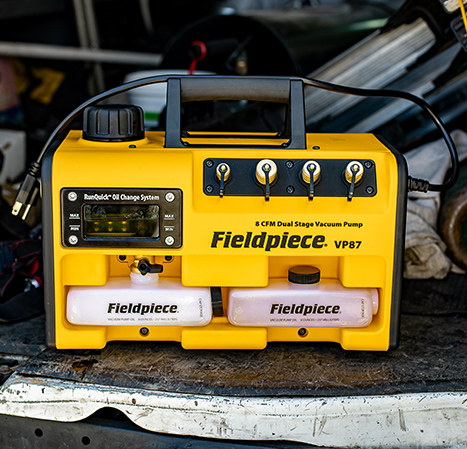
The best HVAC vacuum pumps also have technology that allows you to change oil without powering down and losing vacuum. The Fieldpiece VP67, VP87 and VPX7 with the RunQuick® oil change system are great examples, allowing for oil changes in less than 30 seconds with no mess.

Flow Rate: CFM

The vacuum flow rate is another critical factor to consider when purchasing a HVAC vacuum pump. The cubic feet per minute, or CFM, directly affects the time it takes to evacuate the air from the system, and the higher the CFM the faster the job can be completed given proper hose configuration. Most HVAC pumps flow rate vary between 2 and 10 CFM. As a rule of thumb, most residential homes require a 5-CFM pump. Systems with longer line sets require up to 10 CFM.

Pump Power

While pump power and CFM rate are related, they are worth considering separately. Most vacuum pumps have a power rating between 1/4 and 3/4 HP. This gives you an idea of how well the pump operates under real-world conditions.

Ultimate Vacuum Pressure

The ultimate vacuum pressure is the lowest pressure that the vacuum pump can achieve. The lower the pressure, the better the vacuum pump will perform in removing air and moisture from the system. Look for HVAC vacuum pumps with 15 microns ultimate vacuum or better to get the job done.

Size and Portability

The size and portability of the vacuum pump are also essential considerations given the variability of job sites technicians often work in. A vacuum pump that is lightweight and portable is easier to carry around, and does not always result in lesser performance.

Durability

A HVAC vacuum pump is an investment, and you want to ensure that it lasts for a long time. Look for vacuum pumps that are made from durable materials and that have a solid construction. Additionally make sure it has a wide base to help ensure it will not tip over or spill oil.

By considering these factors you can find the right vacuum pump for you and ensure you can service your customers effectively. Fieldpiece offers three levels of HVAC vacuum pumps. With 6 CFM, 8 CFM, and 10 CFM options that both feature the RunQuick® oil change system, and are lightweight and durable, you are sure to find a HVAC vacuum pump to meet your needs.