A how-to for measuring pipe temperatures with the highest accuracy guaranteed using the right large pipe clamp thermocouples, and an exploration of why refrigeration charge, superheat, and subcooling are too critical to be taken lightly.
According to the U.S. Energy and Information Administration, the commercial and residential sectors account for the majority of energy consumption in the nation. Commercial buildings account for the highest usage, making HVACR system efficiency a top priority not only to reduce cost of ownership and meet the environmental challenges we face today but also to ensure HVACR pros keep the contracts they work so hard to earn—and retain long-term clients that are pleased with their efficient and well-maintained systems.
It’s important to measure an accurate superheat and subcooling to help determine an optimal refrigerant charge, because even small inaccuracies can result in: increased cost of ownership over time; lost commercial contracts due to repeated call-backs or subpar efficiency; full system failures due to increased wear and tear and/or spoilage loss due to underperforming refrigeration systems; compliance fines from improper temperature maintenance, and penalties and shut-downs in commercial refrigeration settings.
The stakes are high. So, how can you be certain your readings are accurate?
“Beer Can Cold” Just Doesn’t Cut It on Modern Systems.
Forty-plus years ago when homes were just starting to get A/C window units, it was common to gauge system refrigeration charge by simply grabbing the suction line near the condenser with a bare hand to determine whether it was as cold as a frosty cool beer should be, hence the term “beer can cold.” If it wasn’t, we added refrigerant. If it was, we considered the job done.
It was highly subjective and massively imprecise, but it passed as a rule of thumb for these older systems that were built for hardiness vs. efficiency. Their compressors were oversized, their coils had extra room around them, and their fan motors had high horsepower—leaving a good amount of flexibility in the amount of refrigerant used.
Today’s critically charged systems, however, are built tightly and precisely, and made for efficiency. This means refrigerant charge has to be within ounces of the correct amount…or else. Instead of guessing with our hands for an arbitrary measurement, accuracy is necessary, especially with today’s precision-engineered systems. Taking accurate measurements of both the superheat on the suction line and subcooling on the liquid line are critical to ensure system efficiency is the industry gold standard.
Why Superheat & Subcooling Matter.
Most techs always check out a system’s refrigerant charge, but superheat and subcooling readings are often something we learn about in school and then don’t think much about in daily life. That said, these readings can be a critical tool in an HVACR pro’s troubleshooting arsenal and can make more difference than many techs realize.
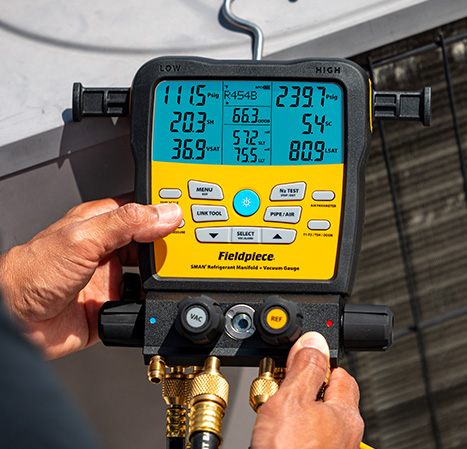
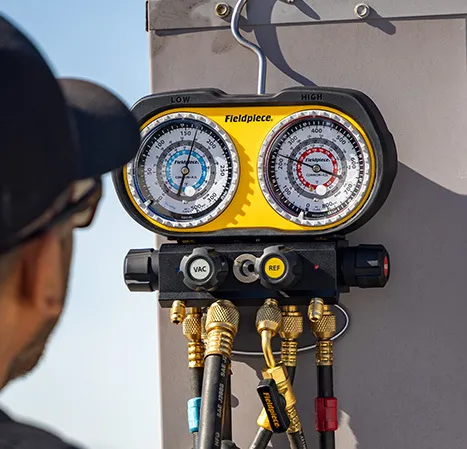
Superheat and subcooling calculations can provide vital clues as to where a system failure is occurring to help technicians zero in on where a problem lies. As a refresher, to figure out superheat measurement, two measurements are taken from the suction line: one for pressure and one for temperature. Superheat is the number of degrees above the temperature that refrigerant changes from liquid to gas. The rule of thumb is that it should be between 8-12 degrees superheat, but of course, we should always default to the manufacturer’s recommendation to be sure that only gas enters the compressor and no liquid is trickling in where it doesn’t belong.
Subcooling involves two measurements as well: one for pressure and one for temperature, but this one is taken from the liquid line. In this case, the rule of thumb is 8-14 degrees below the temperature that gas turns to liquid to be in the safe zone to ensure only liquid is fed into the metering device. Again, it is always best to adhere to the manufacturer’s recommendations.
An improper superheat value can indicate a range of issues such as a clogged filter drier, a refrigerant undercharge or overcharge or improper airflow. A bad subcooling value can indicate an overcharge or undercharge, liquid-line restriction or insufficient condenser airflow. Miscalculated readings can cause a technician to overcharge the system and compromise the compressor.
Just as we know that, with refrigerant, too much or too little are common issues—with too little often indicating a system leak—most of us are also well-aware that when refrigerant gets to the metering device it needs to be in liquid form, and when it gets to the compressor, it needs to be gas, otherwise a whole host of problems can ensue. Why then, don’t we take these measurements on every system, every time?
Probably because in the past it has been a big pain in the rear—that’s why!
Tapes, Straps and Zip-Ties, Oh My!
Even getting one reading in the tight spaces and odd corners of most commercial and even residential/light commercial spaces requires some doing. Trying to get multiple readings for superior calculations and advanced troubleshooting has seemed less like a necessity and more like a nice-to-have that’s not quite worth the hassle.
Why? Because most pipe temperature measurement instruments have been designed with tapes that fall off the moment there’s any condensation or straps that require two hands to apply (which often just isn’t possible in small, tight and awkward spaces) as well as zip ties (that may or may not allow for consistent pressure) and let ambient air get in the way of a precise reading.
Techs shouldn’t feel like some sort of a MacGyver, jerry-rigging their tools to get a measurement. We should be able to trust our readings, but unfortunately, with most tools – we just can’t. Even for those pros that feel confident that their technique is flawless, many are blissfully unaware of the common culprits coming between them, their tools and precision work.
PSA: Don’t Believe Every Reading You Take. Most Measurements are Actually Wrong.
It’s estimated that as many as 90% of common pipe temperature readings are wrong. Worried you may be among those putting their trust in a tool that you shouldn’t to get a reading you can’t rely on?
It’s important to know that most tools will easily give you an inaccurate reading due to outside interference—and when it does, you likely won’t even know it. With no systems to alert you that the reading is off, your measurement could be impacted by paint, dirt, ambient air, improper sensor calibration, condensation or insulation that’s gotten caked onto the pipe itself—all factors that can throw a reading off by as much as 3 to 4 degrees, with you none the wiser.
If the readings are off, not only is your client’s system at risk, but so is your professional reputation.
The Rapid Rail™ Sensor Technology Difference.
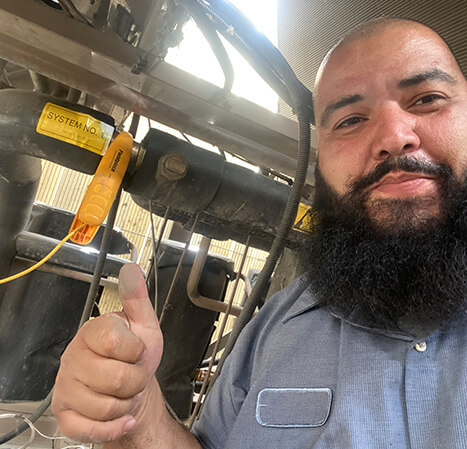
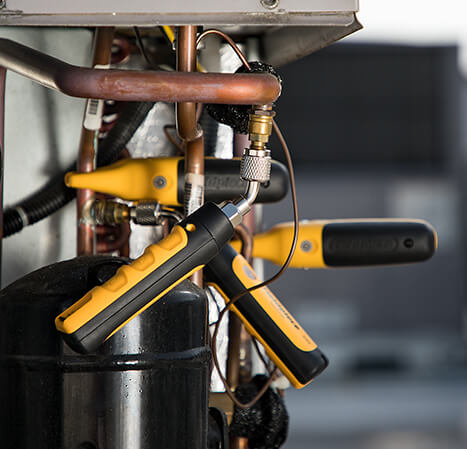
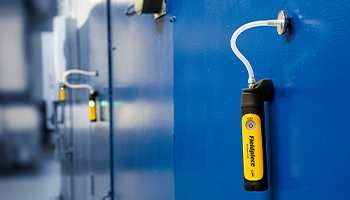
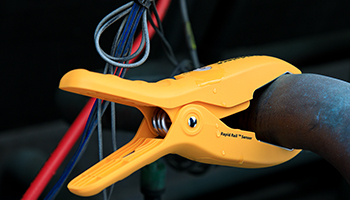
For the types of readings we’re talking about, a clamp design tool is a superior innovation in and of itself to both take a reading with one hand and ensure consistent pressure. You may also have heard about Fieldpiece’s patented Rapid Rail sensor technology. This matters because, with two sensors, one either side of a pipe clamp tool, the electrically conductive pipe itself completes the circuit on both sides to provide a stabilized reading in seconds (versus minutes required for other tools) on a clean pipe. If the pipe clamp detects intrusive elements that can affect readings, such as paint, dirt, dust, grime or the myriad of other factors, it simply will not provide a reading at all, unlike other tools that would provide a false, inaccurate reading.
With Rapid Rail on the wireless JL3LC, hear a single beep? You know it’s working. See a flashing yellow light and hear double beeps? This indicates you do not have a solid connection. You need to use an emery cloth to clean off the pipe to ensure a proper connection. Do this, and your good, clean contact on a pipe will ensure the accuracy of your temperature readings. Knowledge is power, right? What more could you want?
Size. That’s what.
Current products are underwhelming in their range, with the second largest competitor pipe clamp on the market measuring only 3 ½”. That’s why Fieldpiece has innovated yet again to deliver the:
• Large Pipe Clamp Type K Thermocouple TC48
• Job Link® System Premium Large Pipe Clamp Probe JL3LC
Meet the Largest, Most Precise Pipe Clamps in the Industry.
Equipping HVACR pros with the most advanced tools on the market is the Fieldpiece thing to do. Realizing inaccurate readings on large pipes were the status quo but refusing to settle for it, Fieldpiece solved the issues of inconsistency, inaccuracy, improvisation, inconvenience and size through two pipe clamps that can do it all, and do it right the first time – no zip-ties, no waiting, no second-guessing.
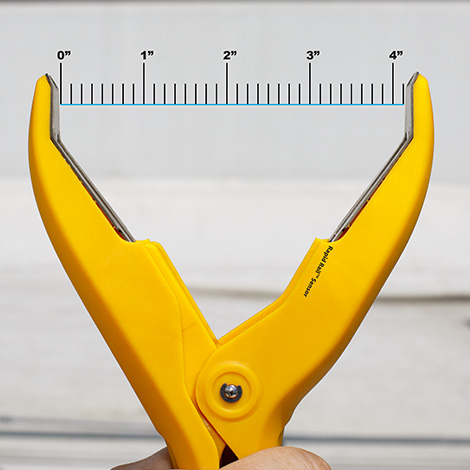
With the ability to measure up to 4 1/8” or to scale down for pipes as small as 3/4”, these high-tech clamps are the largest available on the market.
They are rugged, versatile, water resistant and always spot on, providing highly accurate readings every time. And, with consistent clamping force and our patented Rapid Rail Sensor Technology, they are unaffected by ambient air, dust, paint, corrosion or moisture on the pipe surface.
Plus, with a wired version that offers an extra-long six-foot tangle-free cord eliminating the need to crouch and squat while waiting for a reading, and a wireless version that can take a reading through even the thickest commercial freezer walls, these clamps let you do it all, even with one hand tied behind your back. (Not that you need to be doing tricks, but a one-handed operation does come in pretty darn handy in some of those harder to reach areas.)
With the TC48 and JL3LC, you only get accurate readings. Other tools will deliver readings no matter what, even when they are wrong – leaving techs with little more than a hope and a prayer that they’ve got it right. With Fieldpiece technology, you are guaranteed accuracy, and if there is interference, the TC48 and JL3LC will not generate a reading at all—eliminating false readings and ensuring only precise results.
The Gold Standard for HVACR Requires Constant Innovation.
In the last 40 years, Fieldpiece has led the charge in providing HVACR professionals more than just the basic tools needed for the job. Fieldpiece is always looking for the next innovation; offering new solutions often before techs realize there’s an area for improvement. We’ve worked hard to cultivate a reputation as an “all or nothing” company that believes in accuracy and precision above all else, and we believe that techs should settle for nothing less than the best.
Even way back when “beer can cold” was the go-to approach, Fieldpiece was the first to innovate a tool to calculate superheat/subcooling (it’s ASX14, SSX34), and it wasn’t long before nearly everyone in the field began to realize the importance of these readings. Now, with the addition of the Large Pipe Clamp Type K Thermocouple TC48 and the Job Link System Wireless Large Pipe Clamp JL3LC to its full suite of products, Fieldpiece has innovated yet again.
What’s Next?
Check out our JL3LC Job Link® System Premium Large Pipe Clamp and TC48 Large Pipe Clamp Type K Thermocouple product pages at www.fieldpiece.com for even more details about the features and benefits of these hot new products. Ready to buy? Visit your local distributor to get one on your truck today!
And, trust us that the forward progress won’t stop here. Stay tuned for the next big innovation in HVACR technology by signing up for our newsletter, following us on social media and checking back at www.fieldpiece.com regularly!