




- Merchandise Shop
- Where to Buy
-

 English










 English
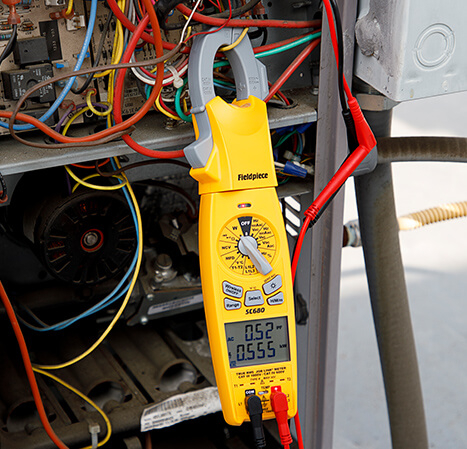
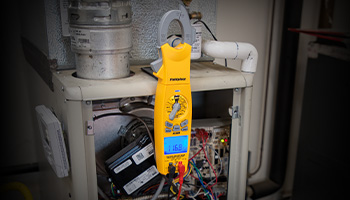
When you arrive at a service call and suspect an electrical fault in a live system, you need a tool that keeps you safe without slowing you down. Technicians rely on clamp meters to measure current without ever breaking the circuit. Whereas a standard multimeter demands that you disconnect conductors to read amperage, a clamp meter’s hinged jaw clamps around a live wire, delivering instant, accurate readings. This capability makes the clamp meter indispensable for HVAC diagnostics.
Clamp meters go beyond simple amp checks. HVAC professionals depend on them for a broad spectrum of electrical troubleshooting tasks. You can capture inrush current during compressor startup, verify balanced loads across three-phase motors, and spot phase imbalances that shorten component life. Many modern clamp meters also integrate voltage measurement, resistance checks, temperature sensing, capacitance testing, and non-contact voltage detection in one compact tool.
Using a clamp meter has distinct advantages on every service call. First, you avoid interrupting the customer’s operation as there is no need to cut wires or shut down systems. Second, the quick-clamp action, large jaw openings, and optional swiveling heads let you work in tight panels or around bulky conduits. Lastly, advanced features such as True RMS accuracy, backlit displays, and backlit dials ensure reliable readings under all field conditions. These benefits translate into faster diagnostics, fewer callbacks, and increased on-the-job safety.
Selecting the right clamp meter begins with understanding the demands of your work. Consider max amperage first to ensure it can safely measure the expected load without being damaged. Also consider jaw opening size: large enough to clamp around conductors, while compact enough to access wires in tight spaces. Look for AC and DC measurement capability along with voltage and resistance ranges to cover all your basic tests. Verify that the meter carries a CAT III or CAT IV safety rating for industrial environments. Additional features such as built-in flashlights, temperature probe inputs or wireless data transfer to a job-site app can further streamline your workflow.
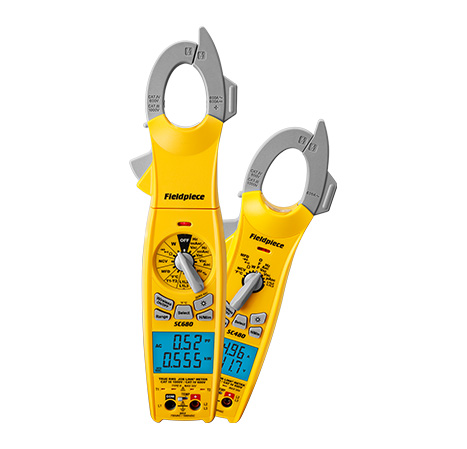
Fieldpiece offers a variety of clamp meters engineered for real-world HVAC challenges. The compact SC260 clamp meter delivers AC current measurement, voltage, resistance, and temperature functions in a compact housing that fits your belt pouch. For advanced troubleshooting, the SC680 adds power quality analysis, phase rotation detection, a 180° rotating head, and wireless integration with the Job Link® System. Both models feature True RMS, large backlit displays, and rugged housing built for contractor demands.
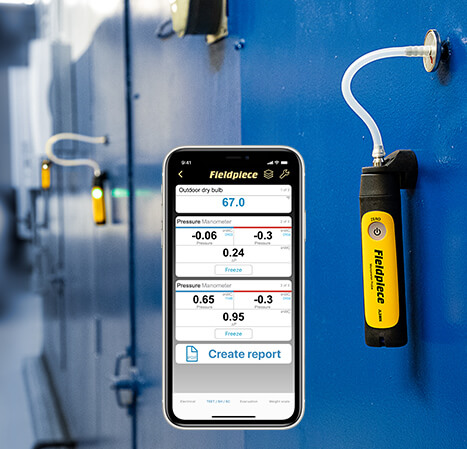
Wireless connectivity changes the way you document and share data. With the Job Link® System app, clamp meter readings are transmitted in real time to your smartphone or tablet. This allows you, for instance, to get amp draw while keeping a blower door closed. You can create professional job reports on the spot, which not only enhances customer confidence but also simplifies record-keeping for maintenance programs.
Always inspect the clamp meter’s jaw for debris or damage before use. Position the jaw around only one wire at a time to avoid false readings. When checking high-current circuits, stand clear of exposed bus bars and wear appropriate personal protective equipment. Confirm the safety rating matches the voltage category of your application. By following these practices, you maximize the tool’s lifespan and your own safety on every job.
A clamp meter is more than a measurement device. It is a diagnostic tool that enhances safety, efficiency, and precision in the field. For HVAC professionals, choosing a high-performance clamp meter is critical to maintaining system performance and ensuring customer satisfaction.
If you need a reliable way to troubleshoot electrical issues without interrupting service, explore the Fieldpiece line of clamp meters and see how our tools help you work easier, faster and better.